

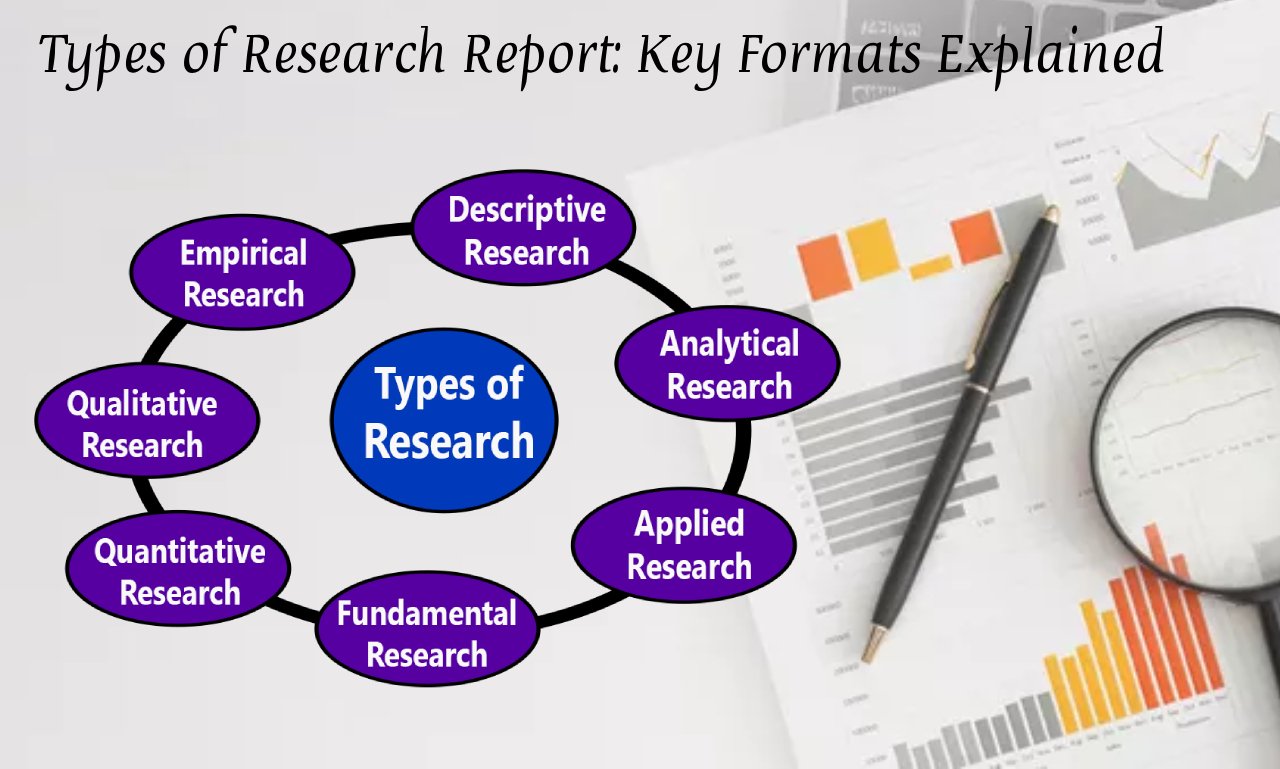
Types of Research Report: Key Formats Explained
Understanding Research Reports
If you’ve ever wondered why research reports are so widely used across academics, businesses, and even government agencies, you’re in the right place. A research report is more than just a document—it’s a structured way of presenting findings, insights, and recommendations. Whether you’re a student, professional, or entrepreneur, understanding the types of research report can dramatically improve how you communicate information and make decisions.
In this guide, we’ll break down the key formats of research reports, explore their unique characteristics, and offer practical examples that you can apply immediately. By the end, you’ll not only know the types of research report but also how to create reports that stand out in clarity, accuracy, and impact.
What is a Research Report?
A research report is a formal document that presents the results of an investigation, analysis, or study. It goes beyond casual observation—it’s structured, evidence-based, and intended to inform or persuade an audience. The purpose can vary widely: from academic assessment to business decision-making or scientific communication.
Every research report typically includes:
- Title page – Identifies the report topic, author, and date.
- Abstract or summary – A brief overview of the key points.
- Introduction – Explains the purpose, scope, and background.
- Methodology – Details how data was collected and analyzed.
- Results/Findings – Presents the main outcomes.
- Discussion/Analysis – Explains the significance of the findings.
- Conclusion/Recommendations – Summarizes insights and suggests next steps.
- References – Lists sources consulted.
With that foundation, it’s time to explore the types of research report and their distinct formats.
Academic Research Reports
Academic research reports are often required in schools, colleges, and universities. They emphasize methodology, evidence, and scholarly rigor.
Experimental Research Reports
These reports are common in sciences like biology, chemistry, or physics. They document experiments conducted to test a hypothesis.
Key Features:
- Clear research question or hypothesis
- Description of materials, methods, and procedures
- Data tables, graphs, and charts
- Analysis of results with statistical evidence
- Conclusion relating results to the original hypothesis
Example: A chemistry student conducting an experiment on reaction rates may produce an experimental research report that explains every step from setup to conclusion.
Descriptive Research Reports
Descriptive reports aim to describe phenomena or events as they occur. These are less about cause-effect relationships and more about observation.
Key Features:
- Surveys or observational data
- Detailed description of findings
- Minimal hypothesis testing
- Structured tables, charts, or visuals for clarity
Example: A sociologist studying urban traffic patterns might write a descriptive report summarizing patterns observed at different times of the day.
Analytical Research Reports
Analytical reports go beyond description. They interpret data, explain why events occur, and offer insights.
Key Features:
- Critical evaluation of data
- Cause-effect analysis
- Evidence-based interpretations
- Recommendations for action
Example: An economics student analyzing market trends may produce an analytical report that not only shows statistics but explains the underlying causes and predicts future trends.
Business Research Reports
In the corporate world, research reports guide strategic decision-making. They are concise, actionable, and focused on problem-solving.
Feasibility Reports
Feasibility reports evaluate whether a proposed project or initiative is practical and viable.
Key Features:
- Objectives of the project
- Cost-benefit analysis
- Potential risks and solutions
- Recommendation on proceeding
Example: A company considering launching a new product might produce a feasibility report assessing market demand, investment needs, and expected returns.
Analytical Business Reports
These reports analyze business problems and provide data-backed solutions.
Key Features:
- Performance evaluation
- Market research analysis
- Financial and operational insights
- Recommendations and action plans
Example: A marketing team could analyze the effectiveness of a recent campaign and produce an analytical report highlighting strengths, weaknesses, and improvement strategies.
Progress Reports
Progress reports track the development of projects over time.
Key Features:
- Status updates
- Milestones achieved
- Challenges faced
- Plans for next steps
Example: A software development team may produce weekly progress reports to keep stakeholders informed on tasks completed, bugs fixed, and upcoming targets.
Scientific and Technical Research Reports
These reports are often used in labs, healthcare, engineering, and IT research. Precision and clarity are key.
Laboratory Reports
Lab reports are detailed documents that present experiments, observations, and results.
Key Features:
- Objective statement
- Materials and methods
- Experimental results
- Graphs, tables, and charts
- Conclusion based on evidence
Technical Research Reports
Technical reports focus on processes, systems, or technological innovations.
Key Features:
- Problem definition
- Methodology and procedures
- Technical specifications and results
- Recommendations for implementation
Example: Engineers testing a new software algorithm may submit a technical report describing performance metrics, system behavior, and suggestions for optimization.
Government and Policy Research Reports
Governments, NGOs, and public organizations rely on research reports for policy-making and program evaluation.
H3: Policy Analysis Reports
These reports examine existing policies or propose new ones.
Key Features:
- Objective evaluation of policies
- Statistical and survey data
- Pros and cons of implementation
- Recommendations for policymakers
Example: A public health agency may produce a policy report on vaccination coverage, highlighting gaps and proposing interventions.
Statistical Research Reports
Statistical reports focus on collecting, analyzing, and presenting numerical data.
Key Features:
- Large datasets
- Charts, graphs, and tables
- Trend analysis
- Evidence-based conclusions
Example: Census data reports are classic statistical research reports, summarizing population trends, demographics, and regional variations.
Creative Ways to Present Research Reports
Presentation matters. While content is king, the way you present your research report can dramatically improve readability and engagement.
- Use tables and charts to visualize data.
- Incorporate infographics for complex findings.
- Break up text with headings and subheadings.
- Include bullet points for clarity.
- Summarize key insights in a one-page executive summary.
Common Mistakes to Avoid in Research Reports
Even seasoned researchers can make mistakes. Avoid these pitfalls to ensure your report stands out:
- Lack of structure: Skipping key sections can confuse readers.
- Overloading with data: Too many tables or charts without explanation can overwhelm.
- Ignoring audience: Tailor language and detail to your readers.
- Poor referencing: Credibility drops if sources are missing.
- Neglecting proofreading: Typos and errors reduce professionalism.
Key Takeaways
Understanding the types of research report is essential for any researcher, student, or professional. Academic reports differ from business or technical reports, but all share a core goal: presenting information clearly and effectively.
By choosing the right format, applying a structured approach, and emphasizing clarity, your research report can influence decisions, inspire action, and communicate insights efficiently. Remember: a well-crafted report is not just a document—it’s a reflection of your analytical skills, credibility, and expertise.
Conclusion: Make Your Reports Count
Research reports are more than a requirement—they’re a tool for impact. Whether you’re presenting findings to a professor, pitching to stakeholders, or contributing to scientific knowledge, knowing the types of research report ensures your work is precise, credible, and persuasive.
Start practicing today. Experiment with different formats, use visuals effectively, and always keep your audience in mind. Your next report could be the one that informs, convinces, and leaves a lasting impression.